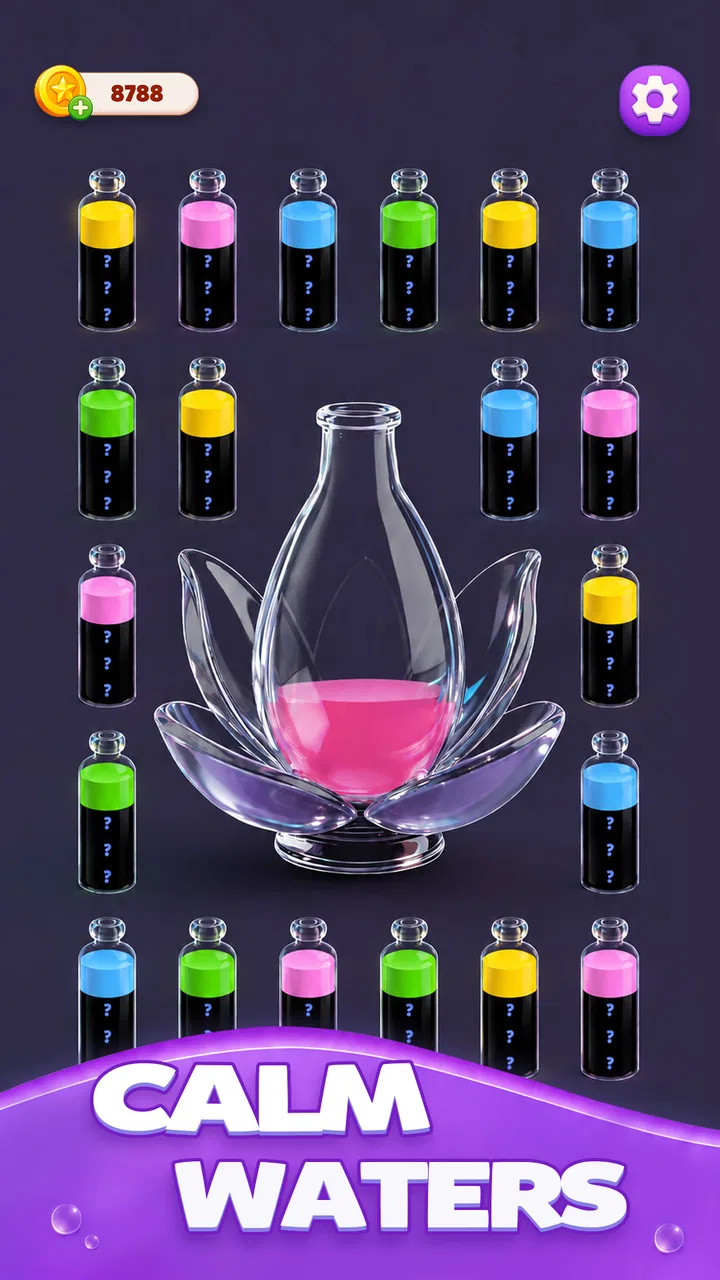
Water Match® - ASMR Water Sort
- 4.8
- Rating
- 10.00M
- Installs
- Free
- Price

 Analysis by App-foxy
I picked up Water Match™- ASMR Water Sort expecting a quick color-matching distraction, and that is exactly where it works best: in the small gaps of an ordinary day. The idea is simple enough to understand immediately, but arranging the colored liquids into matching bottles gives each move a little more weight than a basic tap game. I found myself playing it while waiting for food, taking a short break, or sitting with someone else who wanted to try a level without committing to a long session.
This is a casual game from TAP GAMES, available for free and rated for Everyone. Its store summary focuses on tapping and matching bottles, but the useful part is how that simple loop creates a quiet sorting puzzle. It is not a story-driven adventure or a competitive multiplayer title. It is a compact brain teaser built around visual order, patience, and the satisfaction of finishing a messy arrangement.
How Water Match fits into everyday shared use
The most natural household scenario is a shared device on a kitchen counter or living-room table. One person starts a level, another notices the colored bottles, and the game becomes something to pass back and forth. Because the rules are visible on the screen, a new player can usually understand the objective by watching a few moves. I liked that it does not require a long explanation before someone can participate.
You May Also Like

 Google Keep - Notes and lists
Google Keep’s Quiet Growth Shows the Appeal of Simpler Notes
As mobile work gets busier, Google Keep keeps winning a simple contest: capture a thought quickly, find it later, and get on with the day.

 Blood Strike: 2.5 Anniversary
Blood Strike’s Loadouts Turn Every Drop Into a Tactical Gamble
A close look at Blood Strike’s custom loadouts: how fast access to signature weapons reshapes its battle royale rhythm, rewards preparation, and narrows the gap between fights.

 Pandora - Music & Podcasts
Pandora’s Music Is Easy to Start, but Harder to Recover
Pandora’s strength is its low-effort path from a seed to a station. Its weak spot is how much confidence it asks you to place in connection, setup, and quiet recovery.

 8 Ball Pool
 Is Built on Rivalries, Rematches, and Routine
A close look at the rivalries, rematches, shared routines, and unanswered safety questions that turn a quick pool match into a persistent mobile community.

 Samsung Music
’s Quiet Strength Is Playing What You Already Own
Its reach comes less from spectacle than from dependable access to a personal library. That simplicity is both the app’s strongest retention engine and its ceiling.

 AccuWeather: Weather Radar
AccuWeather Review: A Quick, Clear Forecast for Everyday Decisions
For everyday plans, the best forecast is the one you can understand quickly. AccuWeather makes rain timing, radar, and local conditions easy to act on, with a few trade-offs.
More From Our News Desk



That said, I would treat it as a turn-taking game rather than a true cooperative experience. The appeal comes from making the next decision yourself, so two people trying to control the same round at once can become irritating. A better routine is to let one person plan while the other suggests a move, then switch after the level ends. This keeps the shared-device experience friendly instead of turning every bottle into an argument.
It also suits households where people have very different gaming habits. Someone who avoids action games can still understand the bottle-sorting goal, while a regular puzzle player can focus on planning several moves ahead. I would not choose it for a group looking for conversation-heavy party play, but it works well as a low-pressure activity beside a conversation.
One practical tip is to agree before starting whether the player wants hints or independent solving. Even when another person means well, pointing out the obvious-looking move can remove the best part of the puzzle. On a shared phone, this small boundary matters more than it sounds because the game is built around discovering the correct sequence rather than simply reaching the result.
What the first session feels like
The opening experience is deliberately approachable. You see bottles and colors, then begin moving liquid with taps. The visual language does most of the teaching, so I did not need a tutorial-heavy introduction. That makes it convenient for a child, a parent, or a guest using the device briefly, although a player who wants a deeper explanation of every rule may find the presentation quite light.
The basic decision is not just “find the same color.” You also have to preserve space for later moves. Pouring a color into a matching bottle can be correct in the moment but awkward if it blocks the only useful empty container. I found that the game becomes more interesting when I stopped chasing immediate matches and started treating empty space as a resource.
That is one of the less obvious strengths of this format. The bottles make the puzzle readable at a glance, but the order of operations still matters. When I played quickly, I created avoidable dead ends. When I paused to identify which colors were buried and which containers needed to stay open, the same simple interface felt much more thoughtful.
Setting sensible boundaries on a shared device
Because the game is free, it is easy to install for a quick trial, but free does not mean completely frictionless. In-app purchases range from $1.99 to $99.99 per item, so I would not hand the device to a child without first deciding how purchases are handled in the household. The game is rated Everyone, yet an age rating does not replace an adult’s judgment about spending or screen time.
I also recommend agreeing on a basic session rule before sharing the phone. For example, one person can play until a level is complete, then pass the device on. This avoids the familiar “just one more” problem that can stretch a short puzzle break into a much longer session. Since the game is designed for repeated rounds, a clear stopping point is more useful than relying on willpower after every move.
Another boundary is notification and interruption awareness. If someone is using the device for an important message or navigation, this should take priority over a puzzle round. Water Match is easy to reopen later, and there is no good reason for a casual level to compete with a practical household task. Its strength is that it fits around life; it should not take over the schedule.
For a shared tablet, I would keep expectations especially clear. A larger screen can make the colored containers easier for several people to see, but it also makes the device feel like a communal object. Decide who is responsible for keeping the current puzzle intact. Accidentally resetting or changing a round is more frustrating when somebody else has been planning the solution.
Coordinating moves without spoiling the puzzle
Water sort games reward communication, but only when the communication is specific. Instead of saying “move that one,” I found it better to describe the color and the destination: move the top layer of the blue bottle into the bottle that already contains blue, if there is room. This sounds obvious, but precise language prevents two people from reaching for the screen at the same time.
A useful shared approach is to divide the thinking into roles. One player can watch the available empty spaces, while the other tracks which colors are still buried. This is not a built-in team mode; it is simply a way for two people to discuss the same puzzle without both trying to make every decision. It works particularly well when one person enjoys visual scanning and the other prefers planning.
I would also avoid giving a complete solution too early. A better hint is to ask, “Which color is blocking the next useful pour?” That question keeps the player involved and teaches the central idea: temporary moves can create room for a later match. In my experience, this makes the game more satisfying for younger or less experienced players than taking the device and solving the level for them.
There is a trade-off here. Shared play can make a straightforward puzzle feel social, but it can also expose different patience levels. One person may want to test moves immediately, while another wants to map the whole arrangement first. If that difference causes tension, solo play is the better option. The game is calm, but calm visuals do not automatically make every shared session calm.
Age, trust, and the right kind of supervision
The Everyone rating matches the accessible premise: there is no need for combat knowledge, complex controls, or advanced reading to understand the main activity. Still, I would introduce it to a child as a puzzle with optional spending around it, not as a completely consequence-free toy. The relevant trust question is not whether the colors are suitable; it is whether the child understands the household rule about purchases and device use.
For younger players, I would play the first few rounds together. That gives an adult a chance to see how the child handles mistakes, whether the visual colors are easy to distinguish, and whether the child becomes frustrated when a move has to be undone mentally rather than instantly corrected. The same approach works for an older relative who wants a simple game but may need a little time to become comfortable with the tap-and-pour interaction.
I would not use this game as a reward system that depends on endless play. Its short-puzzle structure makes it tempting to add another round after every success. A better arrangement is to connect play to a fixed moment, such as a short break after a household task, then stop at a natural level boundary. That preserves the relaxing quality instead of turning it into a negotiation.
Trust also includes respecting another player’s progress. If a family member is carefully working through a difficult arrangement, do not reset it as a joke or make random moves without permission. Because the puzzle is based on sequence, one careless tap can change the whole situation. On a shared device, courtesy is part of the user experience.
Where it stands beside other casual puzzle choices
Compared with match-three games, Water Match feels slower and more deliberate. Match-three play usually rewards scanning for combinations and reacting to a changing board, while this game asks me to preserve order and manage space. I prefer Water Match when I want a quiet problem to solve rather than a burst of visual activity.
Compared with word puzzles, it is more immediately accessible because the core challenge is visual. There is less dependence on vocabulary, spelling, or language familiarity. That makes it a stronger shared-device choice when the people playing do not have the same reading level or first language. A word game remains better for someone specifically seeking language practice or clues with multiple meanings.
Compared with idle games, this one gives me more direct responsibility for the outcome. I cannot simply wait for progress to accumulate; I have to choose the next move. The downside is that it may feel less rewarding to players who enjoy collecting, upgrading, or watching a long-term system develop. Water Match is about the current arrangement, not about building a large personal collection.
It also differs from traditional board-game apps. A board game often needs several players, a longer session, and more rules to explain. Here, one person can start immediately, and a second person can join informally by offering suggestions. If your household wants a formal shared competition, another category of game will serve you better. If you want something that can be picked up between chores, this format is more practical.
Small strategies that make the puzzles less frustrating
My first recommendation is to resist filling a matching bottle too early when doing so removes your only empty space. The visible match is not always the best move. I now look for colors that are buried under other layers and ask which container must remain available to uncover them. This simple habit prevents many of the self-created jams that made early rounds feel harder than they needed to be.
Second, I use a “temporary home” mindset. A bottle can be useful even when it does not yet contain a complete color group, provided the move creates access to a more important layer. That is the point where the game stops being a sequence of obvious matches and becomes a small planning exercise. It is also a good concept to explain when playing with someone else, because it clarifies why a seemingly untidy move can be correct.
Third, I slow down after a successful pour. The animation and the new arrangement can make the next move look urgent, but there is no advantage in tapping immediately. I take a moment to recount the visible colors, identify the open spaces, and decide whether I am improving the position or merely making a match. This is especially helpful on a shared screen where another person may be offering advice.
Finally, I treat mistakes as information rather than as a reason to rush. If a sequence leaves no useful space, I review the last few decisions and identify the move that closed the route. That approach is more productive than repeatedly tapping at random. It also makes the game a better fit for a short concentration break, because the challenge comes from reasoning rather than speed.
Performance expectations and version context
The game is listed for devices running Android 6.0 or later, which covers a broad range of Android hardware. The current version is 1.14.0. In practical terms, that makes it a reasonable candidate for an older household phone that is not suitable for demanding three-dimensional games, although the exact feel will still depend on the device and its screen.
Its casual design is an advantage for shared use because there is no complicated control scheme to relearn every time the device changes hands. The important interaction is tapping a bottle and choosing where the liquid should go. A smaller phone screen may make color groups harder to inspect for some players, so a tablet or larger display could be more comfortable for two people watching together.
The audience size suggests that it has reached more than a small circle of puzzle fans, with over 5 million installs and a 4.8 average from around 141 thousand ratings. I see that as encouraging context, not a guarantee that every household will enjoy it. Ratings cannot tell me whether the pacing suits a particular player, and the game’s strongest quality remains its simple, focused puzzle loop.
The developer, TAP GAMES, has kept the central concept easy to approach, but the simplicity also sets a limit. Players looking for extensive customization, a narrative campaign, or a robust social layer should not download it expecting those things. The appeal is narrower and clearer: sort the colors, think through the order, and enjoy the clean feeling of completing the arrangement.
Who should install it, and who should skip it
I would recommend it to someone who wants a free casual puzzle for short sessions, especially if visual sorting is more appealing than words, timers, or action. It is also a good fit for a household that occasionally shares a device and wants a game that can be explained by demonstration. The controls are approachable, and the puzzle depth comes from planning rather than complicated rules.
I would be more cautious if you dislike repeated level structures or become annoyed by in-app purchase prompts in free games. The purchase range, from $1.99 to $99.99 per item, is a real reason to set household expectations before letting children use the device. I would also skip it if your main goal is direct online competition, a story, or a substantial progression system.
For people who need a game that can be played with one hand while multitasking, I would still suggest paying attention to the quality of that multitasking. The game may be easy to operate, but the best moves require concentration. It is fine for a quiet pause; it is not ideal when you are simultaneously cooking, crossing a street, or handling anything that demands full attention.
One further exception is color accessibility. The game depends heavily on distinguishing colored liquid groups. If similar shades are difficult for you or someone in your household to separate, the visual puzzle may become tiring even though the mechanics are simple. In that situation, a puzzle based on shapes, numbers, or text could be a better choice.
My household verdict
After spending time with it, I see Water Match as a small, focused game rather than an all-purpose family entertainment app. Its best moment is a quiet shared break: one person holds the device, another notices the blocked color, and both discuss the next move without needing a long tutorial. That kind of coordination feels natural because the puzzle is visible and the objective is easy to explain.
Its limitations are equally clear. It is not truly cooperative, it does not replace a full party game, and free access comes with in-app purchase considerations that deserve adult attention on a shared device. The game also asks for more patience than its cheerful presentation might suggest. A rushed player can make a simple arrangement surprisingly awkward.
For me, the deciding strength is the balance between immediate access and modest strategic depth. I can hand it to someone unfamiliar with mobile games, yet I can still improve my own play by protecting empty spaces, uncovering buried colors, and planning beyond the next match. That is more substance than the basic bottle concept first suggests.
With a 4.8 average and around 1.6 thousand written reviews, it has a strong reception among its audience, while the Everyone rating keeps the premise broadly approachable. I would install it for a household looking for a calm, free sorting puzzle, set a clear rule around purchases and turns, and avoid presenting it as something more social or expansive than it is. For short, thoughtful breaks, it earns my recommendation.
FAQs for Water Match® - ASMR Water Sort
01What is the main objective of Water Match™ - ASMR Water Sort?
Water Match™ - ASMR Water Sort is a calming and engaging puzzle game where the main objective is to sort colored water into separate tubes, ensuring each tube contains only one color. The game is designed to provide a relaxing experience with its ASMR-inspired sounds and visuals, making it perfect for unwinding after a long day.
02Are there any in-game purchases in Water Match™ - ASMR Water Sort?
Yes, Water Match™ offers in-game purchases to enhance the gaming experience. Players can purchase hints, additional moves, or even remove ads for uninterrupted gameplay. While the game is free to download, these optional purchases can help overcome challenging levels more easily.
03Does Water Match™ - ASMR Water Sort require an internet connection to play?
No, Water Match™ - ASMR Water Sort can be played offline, making it an excellent option for entertainment during travel or in areas with limited connectivity. However, some features, like in-game purchases or updates, may require an internet connection to function properly.
04How does Water Match™ - ASMR Water Sort incorporate ASMR elements?
The game integrates ASMR elements through soothing sound effects and visually calming animations. Each action, like pouring water or completing a level, is accompanied by gentle, satisfying sounds designed to create a relaxing atmosphere and enhance the overall sensory experience.
05Is Water Match™ - ASMR Water Sort suitable for all ages?
Yes, Water Match™ is suitable for players of all ages. Its intuitive gameplay mechanics and simple controls make it accessible to younger players, while its progressively challenging levels provide enough depth to keep adults engaged. The game is family-friendly and offers a safe, enjoyable environment for everyone.
Pros
- Visually soothing and engaging gameplay.
- Intuitive controls for quick learning.
- Challenging levels enhance replay value.
- No intrusive ads during gameplay.
- Suitable for all age groups.
Cons
- Limited customization options.
- Can become repetitive over time.
- Requires internet for some features.
- Occasional in-app purchase prompts.
- Sound effects may be distracting.

Water Match® - ASMR Water Sort
Gallery